As Senior Marketing Content Manager at Arrived, I rebuilt “How Arrived Works” around search, structure, and conversion, turning a quiet product page into one of the platform’s strongest entry points for new investors.
At a glance
Company: Arrived, a fractional real estate investment platform (B2C)
Page: “How Arrived Works,” the page that introduces new investors to the platform
My role: strategy, content, and project lead, working with design and legal
Focus: SEO, content structure, design, and conversion
Results: 3x page views · 25% higher conversion rate · 6x backlinks
Why this page mattered
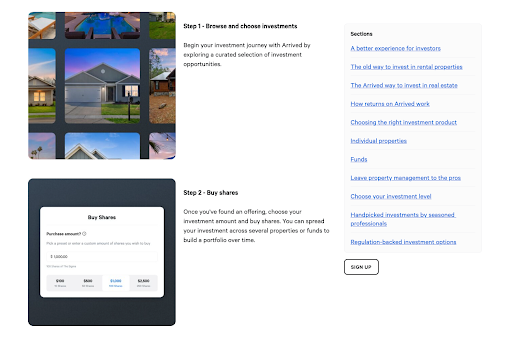
Arrived lets everyday investors buy shares of rental homes and vacation properties. For most visitors, it’s a brand-new idea, so before anyone invests a dollar, they need to understand how it works and trust that it’s legitimate.
“How Arrived Works” was built to do exactly that. It’s the page where curious visitors become confident investors. When it underperforms, every channel that sends people there underperforms with it.
The challenge: good content, low impact
The content on the page was solid. The problem was that almost no one was finding it, and the people who did weren’t sticking around long enough to act.
Traffic: 55 to 238 page views a month, low for a key product page
Authority: only 2 to 6 referring domains, so search engines didn’t treat it as credible
Organic value: $66 to $291 a month in estimated traffic value
Rankings: stuck at 71 to 82 keywords in positions 1 to 4
In short, the page had the right information in the wrong shape: hard to find, hard to scan, and easy to leave.
The approach
Instead of rewriting the page from scratch, I started with an audit of how it was performing in search, how visitors moved through it, and where they dropped off. That showed two separate problems that needed two separate fixes:
Visibility: search engines didn’t see the page as authoritative or relevant, so it wasn’t showing up for the searches that mattered.
Experience: visitors who did arrive had to dig through dense content to find answers, so many left before reaching a call to action.
I treated the page as a system, a hub that needed to attract, guide, and convert, and built a plan that fixed both problems at once.
The optimization
Search visibility: updated keywords, meta titles, headings, and on-page SEO so the page showed up for the right searches, and built backlinks to establish its authority.
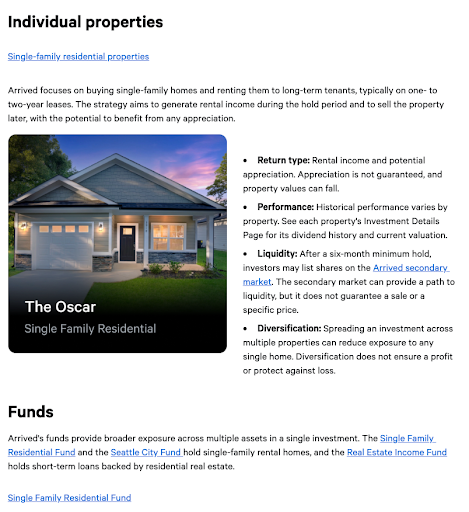
Scannable structure: added jump links at the top and broke content into clear sections with informative subheads, so visitors could get straight to what they cared about.
Visual guidance: redesigned the page’s graphics and added graphic-led calls to action that draw the eye to key next steps without feeling pushy.
User-first flow: reorganized the page around how people actually decide to invest: first understand how Arrived works, then see why it’s credible, then take action.
Conversion details: tuned subheads, section order, and visual cues so every element nudged visitors toward signing up.

Working within compliance
In fintech, persuasive copy also has to be accurate copy. Every change went through legal review, so the page could be clearer and more compelling while staying compliant with investment marketing rules. Building that review into the process from the start meant the updates shipped without rework.
The results
Page views tripled and the conversion rate rose 25%, backed by sharp gains in search authority and visibility.
3x page views (238 → 738 a month)
6x referring domains (5 → 32)
+263% organic traffic value ($291 → $1,057 a month)
+189% top-ranking keywords (74 → 214)
The biggest gains didn’t come from more content. They came from making existing content easier to find and easier to act on. One page, small in scope, ended up driving outsized impact across traffic, authority, and conversions.
It’s the same approach I bring to every marketing program: audit what’s actually happening, fix the system rather than the symptoms, and build it so the results keep compounding.
